25 Sep 2025
Abstract
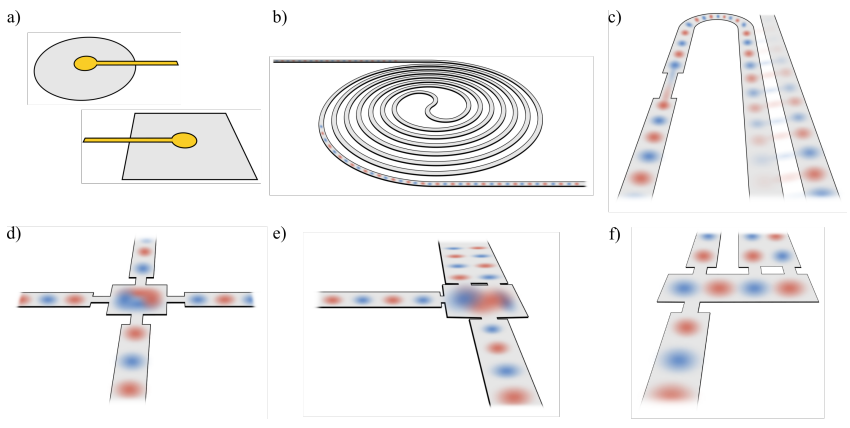
Phononic circuits constructed from high tensile stress membranes offer a range of desirable features such as high acoustic confinement, controllable nonlinearities, low mass, compact footprint, and ease of fabrication. This tutorial presents a systematic approach to modelling and designing phononic integrated circuits on this platform, beginning with acoustic confinement, wave propagation and dispersion, mechanical and actuation nonlinearities, as well as resonator dynamics. By adapting coupled mode theory from optoelectronics to suspended membranes, and validating this theory with several numerical techniques (finite element modelling, finite difference time domain simulations, and the transfer matrix method), we then provide a comprehensive framework to engineer a broad variety of phononic circuit building blocks. As illustrative examples, we describe the implementation of several acoustic circuit elements including resonant and non-resonant variable-ratio power splitters, mode converters, mode (de)multiplexers, and in-line Fabry-Perot cavities based on evanescent tunnel barriers. These building blocks lay the foundation for phononic integrated circuits with applications in sensing, acoustic signal processing, and power-efficient and radiation-hard computing.
Browse Figures
Authors











No Responses